Majestic Nature Matters
Here's a photo that shows how a society with a greater focus on the natural world approaches art. It shows my mother's father's hand-painted birth announcement from Osaka, Japan in the late 1880s. It projects a natural balance.
It also illustrates a point. Our unconscious, from childhood, reflects the world around us. And as the world has modernized, it's lost the perfectly locking puzzle pieces that are wilderness. Instead, arbitrary straight lines and flat urban surfaces have taken over. Likewise, societies have gradually switched over from nature-worship to institutionalized, man-made beauty in the form of religion, ceremony and art. Its as if we were squaring a circle that, as a guide, is gradually fading.
At first this was likely successful, since wild remnants could always be found and revered, giving rise to hybrid forms of wild and human beauty like the above birth announcement. Here, for example, are what look like two puzzle-pieces in a single landscape: forest and grassland. On closer inspection we find that they're actually two types of moss on a forest floor. So the original old-growth forest and flowering prairie may be gone, but if we look hard, even in this modern era, we find interlocking puzzle pieces to remind us of original wilderness.

Unknown, is what'll happen if natural inspiration becomes ever rarer. And, worse yet, if the institutionalized, man-made order found in modern civilization is ever over-taken by over-crowded excess, disease and destructive conflict; what then? In that light, the past few hundred years seem almost like an unwieldy experiment whose outcome is unknown and potentially disastrous.
Here's a visitor to Patriarch's Grove under Mount Rainier in Washington state, a place I visited on that same day.
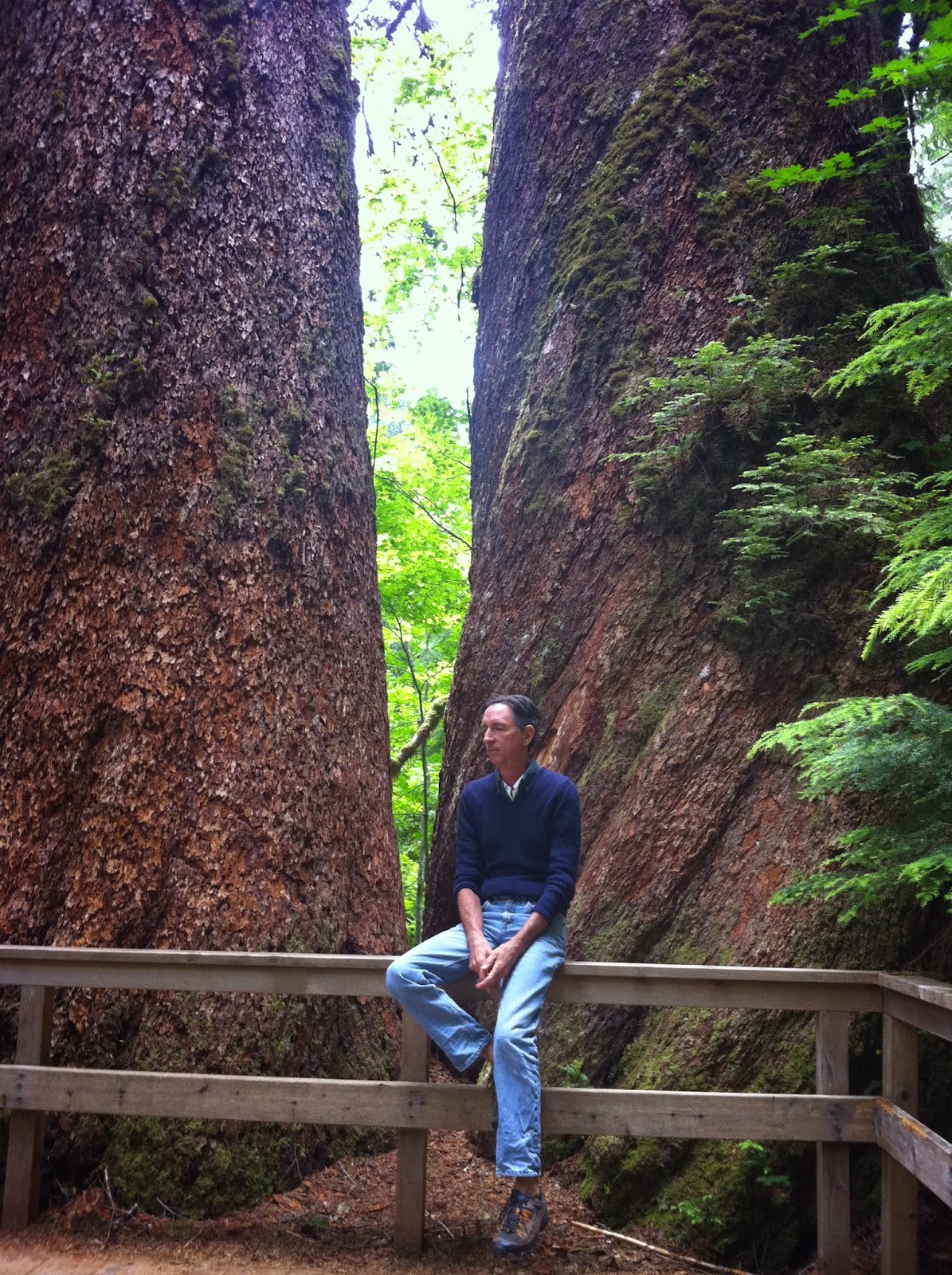
What I'm proposing in these few paragraphs is that being with such splendor--in this case, ancient Douglas fir--would impact default patterns of unconscious / conscious reflection in a visitor's mind. Instead of dwelling on disjointed minor details, the visitor would aim for the big-picture, and in a bold manner.
All of which might suggest that there's truth in Thoreau's line: "in wildness is the preservation of the world".
A final note: A recent study has found that the single biggest determinant for success in life, for those born into poverty, is not parenting, but whether the poor get lucky and grow up in a community with good schools and nice neighbors. Which would suggest that we actually do, to a certain extent, reflect our surroundings.

